




Draped Bust Dime

Obverse (Front) Design

Reverse (Back) Design

Coin Specifications
Date Range
Denomination
Designer / Engraver
Mints
Composition
Precious Metal Content
Weight
Diameter
Edge
Mintage
History & Background
The dime was approved in 1792 but not struck until 1796. The coin has no value mark.
It has two reverses, like the half dime.
Collecting Tips
- Check for cleaning.
- Know the Small and Heraldic Eagle types.
- Buy certified coins.
Photographs by Grade


Draped Bust Dime (1796–1807) - Photographs by Grade
MS61

MS62
MS63
MS64
MS65
Frequently Asked Questions about the Draped Bust Dime
Who designed it?
Robert Scot.
Does it say 10 cents?
No, it has no value mark.
What are the types?
Small Eagle and Heraldic Eagle.
More Half-Dimes and Dimes

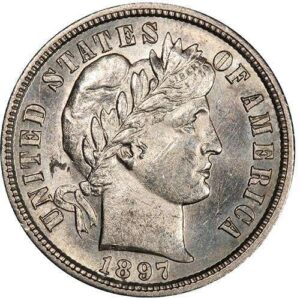
Barber Dime
1892–1916 · 10 Cents (Dime) · 90% silver, 10% copper
The Barber Dime, struck 1892 to 1916, is a 90% silver coin designed by Charles E. Barber and shows a head of Liberty wearing…

Bust Half Dime
1792 · 5 Cents (Half Disme) · 89.24% silver (approx.)
The 1792 Bust Half Dime, or half disme, was a trial coin made during the first year of the United States Mint.

Capped Bust Dime
1809–1837 · 10 Cents (Dime) · 89.24% silver (to 1828); 90% silver (later)
The Capped Bust Dime, struck 1809 to 1837, was designed by John Reich and replaced the Draped Bust dime.

Capped Bust Half Dime
1829–1837 · 5 Cents (Half Dime) · 89.24% silver (to 1836); 90% silver (later)
The Capped Bust Half Dime, struck 1829 to 1837, was made with a close collar for a round shape and a reeded edge.
Buy and sell gold, silver and platinum with Marcus Metals
See live buy and sell prices on bullion bars and coins, or get a quote for your own gold and silver.
