
Mercury Dime

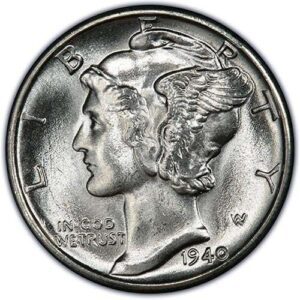
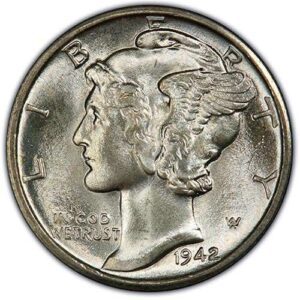
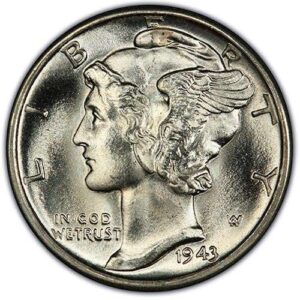
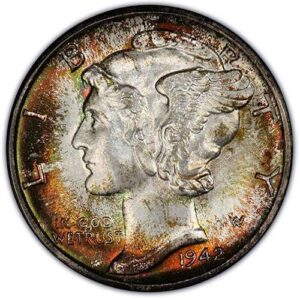
The Mercury Dime, officially the Winged Liberty Head dime, was struck from 1916 to 1945 in 90% silver and is a favorite of silver collectors.
Mercury Dime (1916-1945)

Obverse (Front) Design

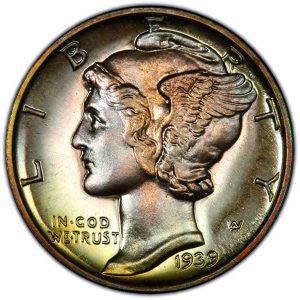
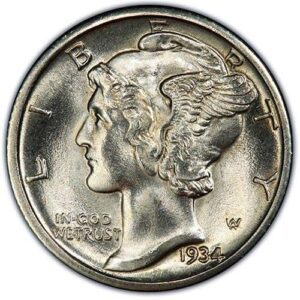
A left-facing head of Liberty wearing a winged cap, a symbol of freedom of thought, with LIBERTY and IN GOD WE TRUST.
Mercury Dime (1916-1945)

Reverse (Back) Design

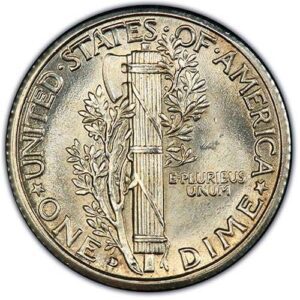
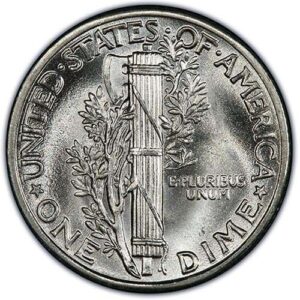
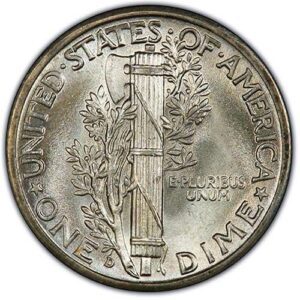
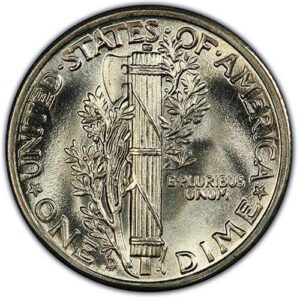
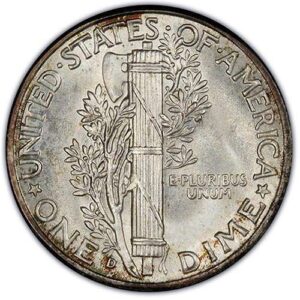
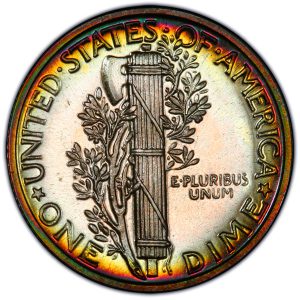
A fasces (a bundle of rods with an ax) wrapped with an olive branch, a symbol of strength and peace.
Mercury Dime (1916-1945) rev

Coin Specifications

Date Range

1916–1945

Denomination

10 Cents (Dime)

Designer / Engraver

Adolph A. Weinman

Mints

Philadelphia, Denver, San Francisco

Composition

90% silver, 10% copper

Precious Metal Content

About 0.0723 troy oz of pure silver

Weight

2.5 g

Diameter

17.9 mm

Edge

Reeded

Mintage

—

History & Background

The Mercury Dime is officially called the Winged Liberty Head dime. People call it the Mercury dime because the winged cap looks like the cap of the Roman god Mercury, but the figure is Liberty. It was designed by Adolph A. Weinman, who also designed the Walking Liberty half dollar.

The coin was made from 1916 until 1945, when it was replaced by the Roosevelt dime. The 1916-D dime had a very low mintage and is the best-known key date.

Collectors look for the Full Split Bands (FSB) designation, which means the two center bands on the fasces on the reverse are fully separated.

Collecting Tips

  • Look for the FSB designation on the reverse; it adds a premium in higher grades.
  • 1916-D, 1921 and 1921-D are the scarcer dates.
  • All Mercury dimes are 90% silver, so even worn coins have metal value.

Photographs by Grade

Frequently Asked Questions about the Mercury Dime

Is the Mercury Dime really Mercury?

No. The figure is Liberty wearing a winged cap, a symbol of freedom of thought. The nickname comes from its resemblance to the Roman god Mercury.

How much silver is in a Mercury dime?

About 0.0723 troy ounces of pure silver.

What does FSB mean?

Full Split Bands. It describes a coin whose fasces bands on the reverse are fully separated and sharply struck.

More Half-Dimes and Dimes

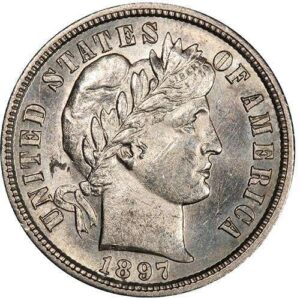
  • Barber Dime

    1892–1916 · 10 Cents (Dime) · 90% silver, 10% copper

    The Barber Dime, struck 1892 to 1916, is a 90% silver coin designed by Charles E. Barber and shows a head of Liberty wearing…

  • Bust Half Dime

    1792 · 5 Cents (Half Disme) · 89.24% silver (approx.)

    The 1792 Bust Half Dime, or half disme, was a trial coin made during the first year of the United States Mint.

  • Capped Bust Dime

    1809–1837 · 10 Cents (Dime) · 89.24% silver (to 1828); 90% silver (later)

    The Capped Bust Dime, struck 1809 to 1837, was designed by John Reich and replaced the Draped Bust dime.

  • Capped Bust Half Dime

    1829–1837 · 5 Cents (Half Dime) · 89.24% silver (to 1836); 90% silver (later)

    The Capped Bust Half Dime, struck 1829 to 1837, was made with a close collar for a round shape and a reeded edge.

See all Half-Dimes and Dimes →

Buy and sell gold, silver and platinum with Marcus Metals

See live buy and sell prices on bullion bars and coins, or get a quote for your own gold and silver.