
Trade Dollar

The Trade Dollar was made from 1873 to 1885 for trade in Asia. It is heavier than a regular silver dollar and shows Liberty seated on bales of goods.
Trade Dollar (1873-1885) o

Obverse (Front) Design

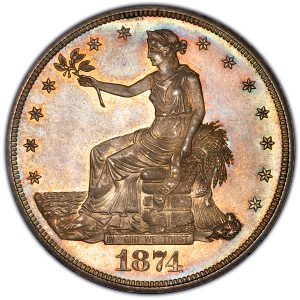
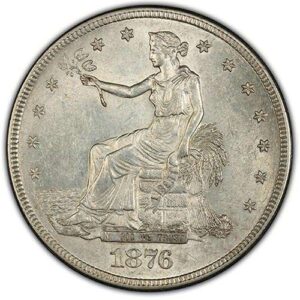
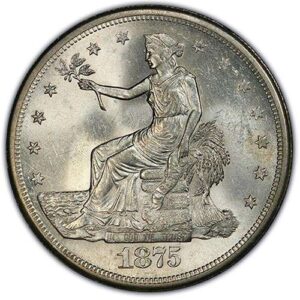
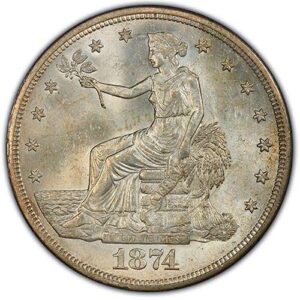
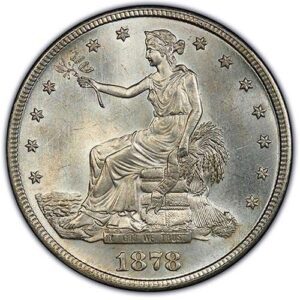
Liberty seated on bales of goods, holding an olive branch and a ribbon inscribed LIBERTY, with stars above and the date below.
Trade Dollar (1873-1885) o

Reverse (Back) Design

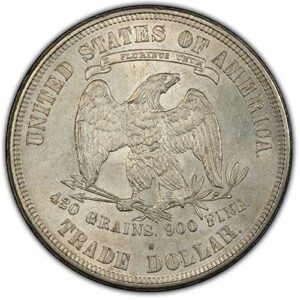
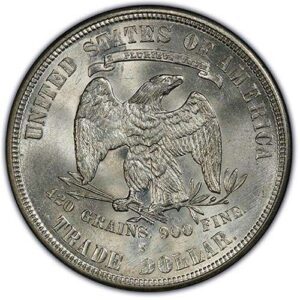
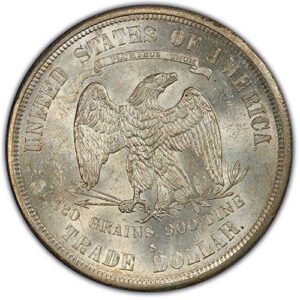
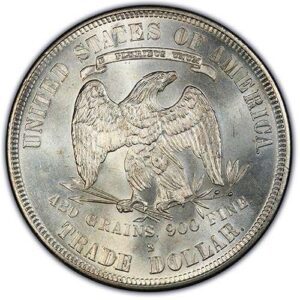
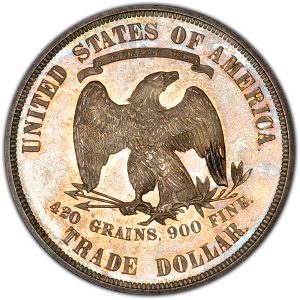
An eagle holding an olive branch and arrows, with the weight and fineness (420 GRAINS, 900 FINE) and the words UNITED STATES OF AMERICA and TRADE DOLLAR.
Trade Dollar (1873-1885) r

Coin Specifications

Date Range

1873–1885

Denomination

1 Dollar (Trade Dollar)

Designer / Engraver

William Barber

Mints

Philadelphia, Carson City (CC), San Francisco (S)

Composition

90% silver, 10% copper

Precious Metal Content

About 0.7874 troy oz of pure silver

Weight

27.22 g

Diameter

38.1 mm

Edge

Reeded

Mintage

—

History & Background

The Trade Dollar was introduced in 1873 so American silver coins could compete with Mexican pesos and other large silver coins in trade with China and the rest of Asia. It was slightly heavier than the standard silver dollar.

The coin was briefly legal tender in the United States, but that status was removed in 1876. Regular production for trade ended in 1878, and later dates through 1885 were struck mostly as proof coins for collectors. The 1884 and 1885 dates are extremely rare.

Many Trade Dollars carry small stamped marks called chop marks, added by merchants in Asia to show that a coin had been checked. These are part of the coin’s history, and collectors often value them.

Collecting Tips

  • Chop-marked coins are collected as their own category; check whether a coin is marked before comparing prices.
  • Look for the weight and fineness statement on the reverse, which is a quick way to identify the type.
  • Be cautious with 1884 and 1885 dates; they are extremely rare and often copied.

Photographs by Grade

Frequently Asked Questions about the Trade Dollar

Why is it called a Trade Dollar?

It was made for overseas trade, especially in Asia, and was heavier than the regular silver dollar.

Was the Trade Dollar legal tender?

It was for a short time, but that status was removed in 1876.

What are chop marks?

Small stamps added by merchants in Asia to show a coin had been checked. Some collectors value them, others prefer unmarked coins.

More Dollars

  • American Innovation Dollar

    2018–2032 · 1 Dollar · 88.5% copper, 6% zinc, 3.5% manganese, 2% nickel

    The American Innovation Dollar program issues dollar coins honoring innovation and innovators in each state, territory and the District of Columbia.

  • Draped Bust Dollar

    1795–1803 (1804 restrikes later) · 1 Dollar · 89.24% silver, 10.76% copper

    The Draped Bust Dollar, struck 1795 to 1804, was designed by Robert Scot and includes the famous 1804 dollar.

  • Eisenhower Dollar

    1971–1978 · 1 Dollar · Copper-nickel clad (circulation); 40% silver (some collector issues, 1971–1974)

    The Eisenhower Dollar, struck 1971 to 1978, honors President Dwight D. Eisenhower and was the last large-size dollar coin made for circulation.

  • Flowing Hair Dollar

    1794–1795 · 1 Dollar · 89.24% silver, 10.76% copper

    The Flowing Hair Dollar, struck in 1794 and 1795, was the first silver dollar made by the United States Mint.


See all Dollars →

Buy and sell gold, silver and platinum with Marcus Metals

See live buy and sell prices on bullion bars and coins, or get a quote for your own gold and silver.