
Gold Dollar Type 1 (1849-1854)

The Type 1 Gold Dollar, struck 1849 to 1854, was the first United States gold dollar and the smallest gold coin the nation ever issued.
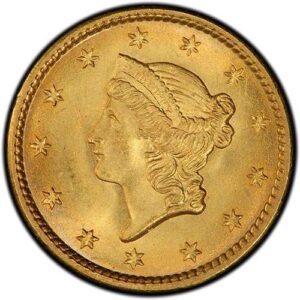
1851 Gold Dollar obv

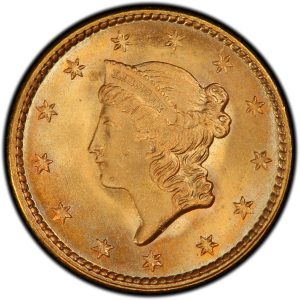
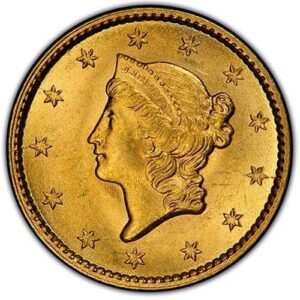
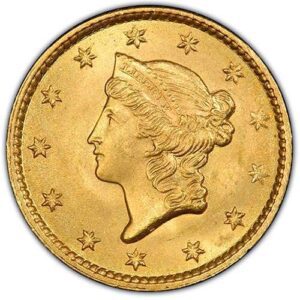
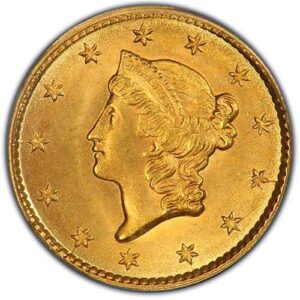
Obverse (Front) Design

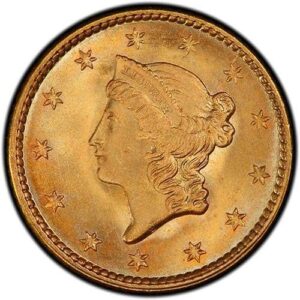
A Liberty head wearing a coronet inscribed LIBERTY, surrounded by thirteen stars, with the date below.
1851 Gold Dollar obv

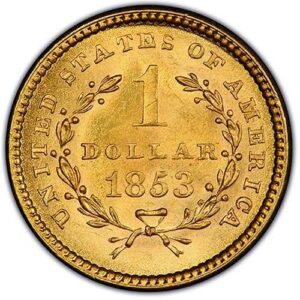
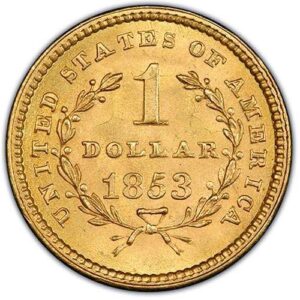
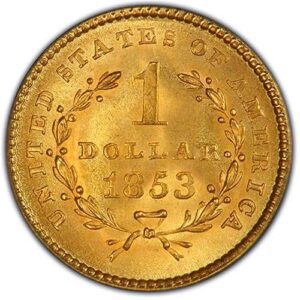
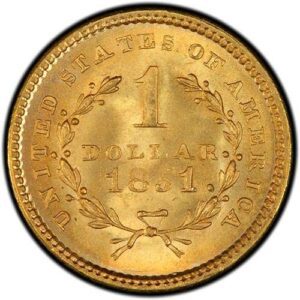
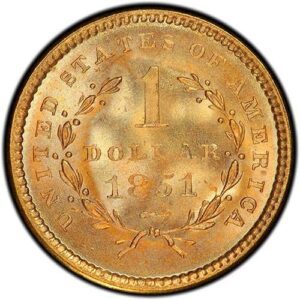
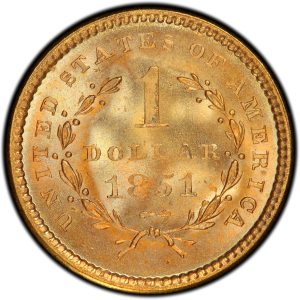
Reverse (Back) Design

A wreath surrounding the numeral 1 and the word DOLLAR, with the date below and UNITED STATES OF AMERICA around the rim.
Gold Dollar Type 1 (1849-1854)

Coin Specifications

Date Range

1849–1854

Denomination

1 Dollar

Designer / Engraver

James B. Longacre

Mints

Philadelphia, Charlotte, Dahlonega, New Orleans

Composition

90% gold, 10% copper

Precious Metal Content

About 0.0484 troy oz of pure gold

Weight

1.672 g

Diameter

13 mm

Edge

Reeded

Mintage

Varies by date and mint

History & Background

The Type 1 Gold Dollar was authorized by the Act of March 3, 1849, at the height of the California Gold Rush, when large amounts of new gold were entering the economy. It was the first United States gold dollar and, at 13 mm across, the smallest gold coin the country has ever issued.

Design

James B. Longacre designed the coin. The front shows a Liberty head surrounded by stars, and the back shows a wreath around the denomination and date.

Mints and varieties

Type 1 gold dollars were struck from 1849 through 1854 at Philadelphia and at the branch mints in Charlotte, Dahlonega and New Orleans. Coins from the branch mints are usually scarcer than Philadelphia issues and are often in demand with collectors.

Why the design changed

The coin’s very small size was a practical problem, and in 1854 it was replaced by a larger, thinner Indian Princess design known as Type 2. A third type followed in 1856.

Collecting Tips

  • Look for weak strikes, especially on the stars and the date.
  • Many gold dollars were used in jewelry; check for mount marks, solder or repairs.
  • Branch-mint coins (C, D and O mint marks) carry premiums over Philadelphia coins.
  • Buy certified examples when paying for higher grades.

Photographs by Grade

Frequently Asked Questions about the Gold Dollar Type 1 (1849-1854)

How much gold is in a Type 1 Gold Dollar?

It weighs 1.672 grams and is 90% gold, which is about 0.0484 troy ounces of pure gold. Collector value is usually well above the metal value.

Why are there three types of gold dollar?

The design was changed twice, in 1854 and 1856, mainly because the original 13 mm coin was so small. Type 1 is the earliest and smallest.

Which mints made Type 1 gold dollars?

Philadelphia, Charlotte (C), Dahlonega (D) and New Orleans (O).

More Gold Coins

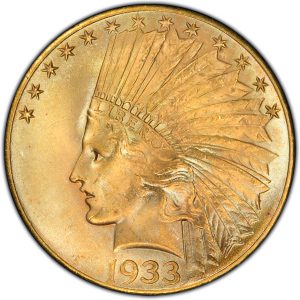
  • Indian $10 Eagle (1907-1933)

    1907–1933 · 10 Dollars (Eagle) · 90% gold, 10% copper

    The Indian Head $10 Eagle, struck 1907 to 1933, is a 90% gold coin designed by Augustus Saint-Gaudens.

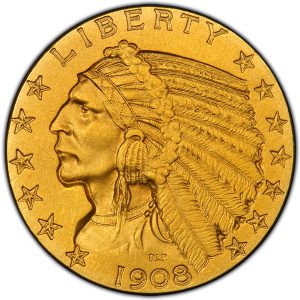
  • Indian $5 Half Eagle (1908-1929)

    1908–1929 · 5 Dollars (Half Eagle) · 90% gold, 10% copper

    The Indian Head $5 Half Eagle, struck 1908 to 1929, is a 90% gold coin with an unusual incuse design that is sunk into…

  • Liberty Head $20 Double Eagle (1849-1907)

    1849–1907 · 20 Dollars (Double Eagle) · 90% gold, 10% copper

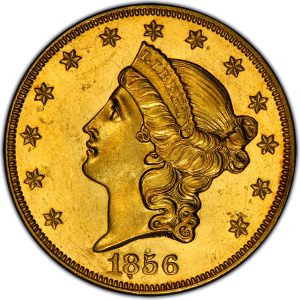
    The Liberty Head Double Eagle, authorized in 1849 and struck from 1850 to 1907, is a large 90% gold $20 coin from the Gold…

  • Saint-Gaudens $20 Double Eagle (1907-1933)

    1907–1933 · 20 Dollars (Double Eagle) · 90% gold, 10% copper

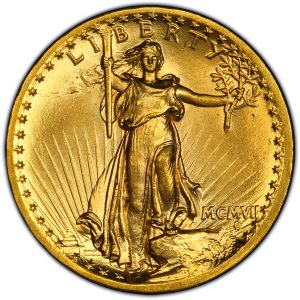
    The Saint-Gaudens Double Eagle, struck 1907 to 1933, is a 90% gold $20 coin widely called one of the most beautiful American coins.
See all Gold Coins →

Buy and sell gold, silver and platinum with Marcus Metals

See live buy and sell prices on bullion bars and coins, or get a quote for your own gold and silver.