
Liberty Head $20 Double Eagle (1849-1907)

The Liberty Head Double Eagle, authorized in 1849 and struck from 1850 to 1907, is a large 90% gold $20 coin from the Gold Rush era.
Liberty Head $20 Double Eagle (1849-1907) obs

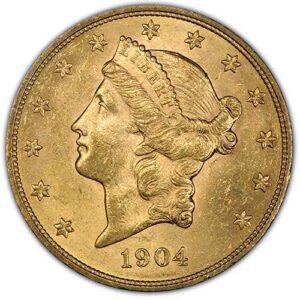
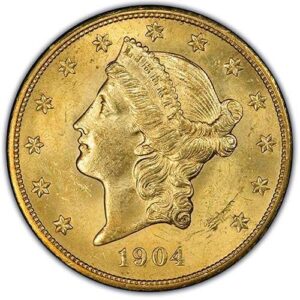
Obverse (Front) Design

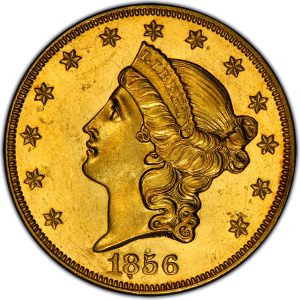
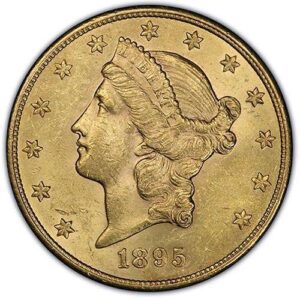
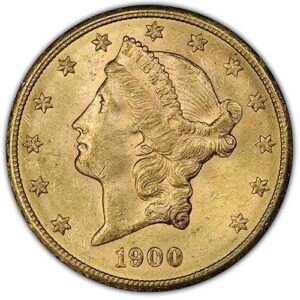
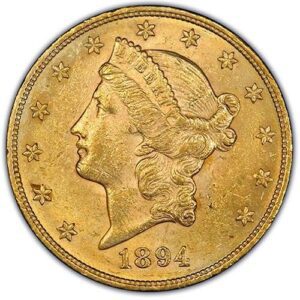
A left-facing head of Liberty wearing a coronet inscribed LIBERTY, surrounded by thirteen stars, with the date below.
Liberty Head $20 Double Eagle (1849-1907) obs

Reverse (Back) Design

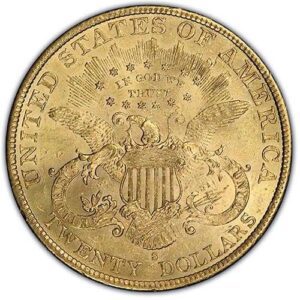
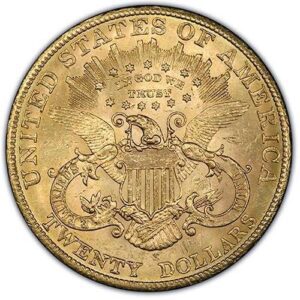
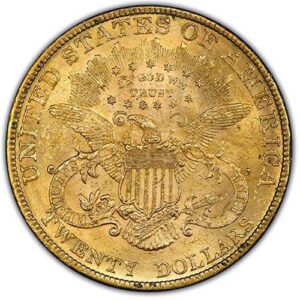
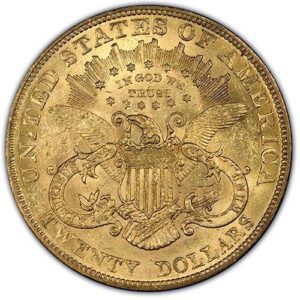
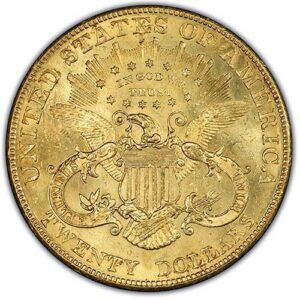
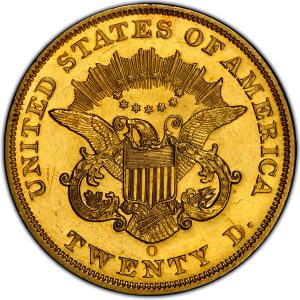
A heraldic eagle with a shield on its chest, holding arrows and an olive branch, with the denomination below.
Liberty Head $20 Double Eagle (1849-1907) rev

Coin Specifications

Date Range

1849–1907

Denomination

20 Dollars (Double Eagle)

Designer / Engraver

James B. Longacre

Mints

Philadelphia, San Francisco (S), New Orleans (O), Carson City (CC), Denver (D, 1906–1907)

Composition

90% gold, 10% copper

Precious Metal Content

About 0.9675 troy oz of pure gold

Weight

33.436 g

Diameter

34 mm

Edge

Reeded

Mintage

—

History & Background

The Liberty Head Double Eagle was authorized by the Act of March 3, 1849, the same law that created the gold dollar. California gold had created a need for a large gold coin. It was the largest United States gold coin made for regular use and was designed by James B. Longacre.

The coin is divided into three types. The first type (1850–1866) has no motto. The second type (1866–1876) adds IN GOD WE TRUST and the abbreviation TWENTY D. The third type (1877–1907) spells out TWENTY DOLLARS.

Double Eagles were struck at Philadelphia, San Francisco, New Orleans, Carson City and, late in the series, Denver. They were used widely in international trade and in bank holdings. The design was replaced by the Saint-Gaudens Double Eagle in 1907.

Collecting Tips

  • Common dates in lower grades are often priced close to their gold value.
  • Carson City and New Orleans coins are scarcer and carry premiums.
  • Buy certified coins for any higher-priced date or grade.
  • Check the type (I, II or III), since the three types are priced differently.

Photographs by Grade

Frequently Asked Questions about the Liberty Head $20 Double Eagle (1849-1907)

How much gold is in a Liberty Head double eagle?

About 0.9675 troy ounces of pure gold.

What are the three types?

Type I (1850–1866) has no motto. Type II (1866–1876) has IN GOD WE TRUST and TWENTY D. Type III (1877–1907) reads TWENTY DOLLARS.

Which mints struck it?

Philadelphia, San Francisco (S), New Orleans (O), Carson City (CC) and, in 1906 and 1907, Denver (D).

More Gold Coins

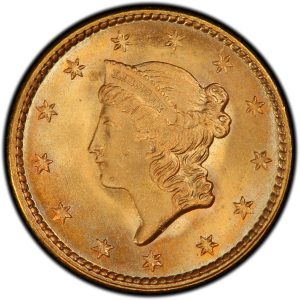
  • Gold Dollar Type 1 (1849-1854)

    1849–1854 · 1 Dollar · 90% gold, 10% copper

    The Type 1 Gold Dollar, struck 1849 to 1854, was the first United States gold dollar and the smallest gold coin the nation ever…

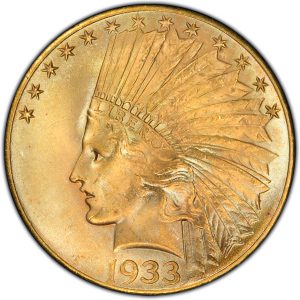
  • Indian $10 Eagle (1907-1933)

    1907–1933 · 10 Dollars (Eagle) · 90% gold, 10% copper

    The Indian Head $10 Eagle, struck 1907 to 1933, is a 90% gold coin designed by Augustus Saint-Gaudens.

  • Indian $5 Half Eagle (1908-1929)

    1908–1929 · 5 Dollars (Half Eagle) · 90% gold, 10% copper

    The Indian Head $5 Half Eagle, struck 1908 to 1929, is a 90% gold coin with an unusual incuse design that is sunk into…

  • Saint-Gaudens $20 Double Eagle (1907-1933)

    1907–1933 · 20 Dollars (Double Eagle) · 90% gold, 10% copper

    The Saint-Gaudens Double Eagle, struck 1907 to 1933, is a 90% gold $20 coin widely called one of the most beautiful American coins.
See all Gold Coins →

Buy and sell gold, silver and platinum with Marcus Metals

See live buy and sell prices on bullion bars and coins, or get a quote for your own gold and silver.