
Three-Dollar Gold Piece (1854-1889)

The Three-Dollar Gold Piece, struck 1854 to 1889, is one of the most unusual United States coins, a 90% gold coin with a face value of three dollars.
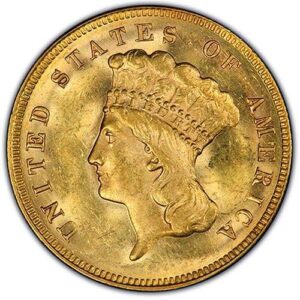
Three-Dollar Gold Piece (1854-1889) obv

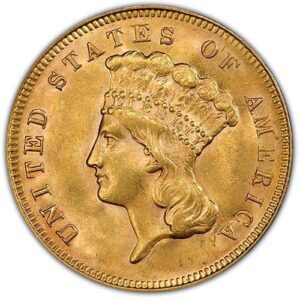
Obverse (Front) Design

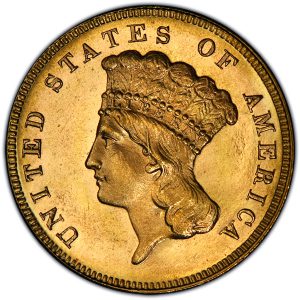
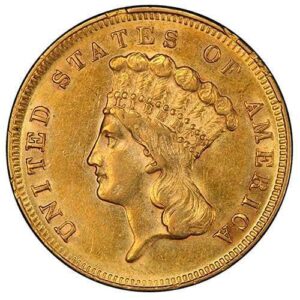
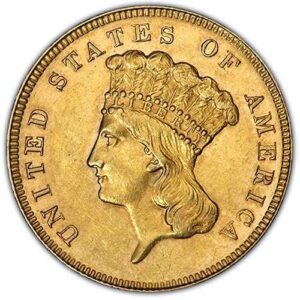
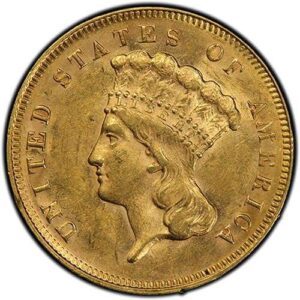
A left-facing head of Liberty in a feathered headdress, with the words UNITED STATES OF AMERICA around.
Three-Dollar Gold Piece (1854-1889) obv

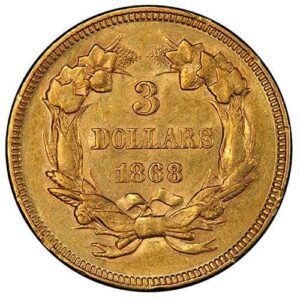
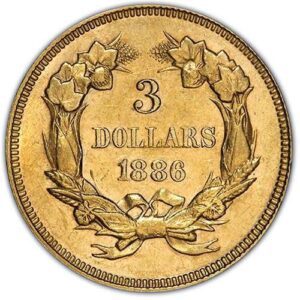
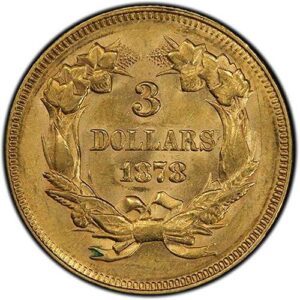
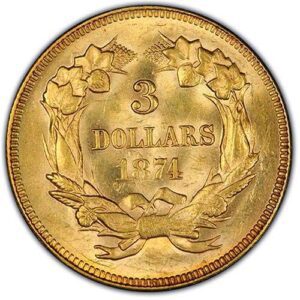
Reverse (Back) Design

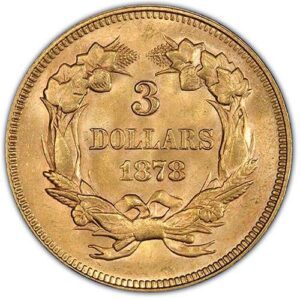
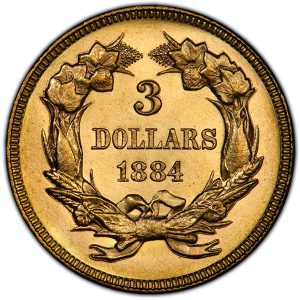
A wreath of crops, with the denomination and date inside.
Three-Dollar Gold Piece (1854-1889) rev

Coin Specifications

Date Range

1854–1889

Denomination

3 Dollars

Designer / Engraver

James B. Longacre

Mints

Philadelphia, Dahlonega (1854), New Orleans (1854), San Francisco

Composition

90% gold, 10% copper

Precious Metal Content

About 0.1451 troy oz of pure gold

Weight

5.015 g

Diameter

20.5 mm

Edge

Reeded

Mintage

—

History & Background

The Three-Dollar Gold Piece was authorized by Congress in 1853 and first struck in 1854. It was designed by James B. Longacre. The three-dollar value is often explained as being useful for buying sheets of three-cent stamps and three-cent silver coins, though the coin never became popular.

It was struck at Philadelphia for the whole run and at Dahlonega, New Orleans and San Francisco in some early years. By the end of the 1800s there was little demand, and production ended in 1889.

Today the Three-Dollar Gold Piece is popular with collectors because of its unusual denomination and its small mintages.

Collecting Tips

  • Most dates are scarce, and many are priced well above gold value.
  • Check for cleaning, jewelry use and edge damage.
  • Buy certified coins from trusted dealers.

Photographs by Grade

Frequently Asked Questions about the Three-Dollar Gold Piece (1854-1889)

Why was there a three-dollar coin?

Congress authorized it in 1853. It is often explained as being convenient for postal purchases, but it never became popular.

How much gold is in it?

About 0.1451 troy ounces of pure gold.

Is it rare?

Many dates are scarce, since mintages were small.

More Gold Coins

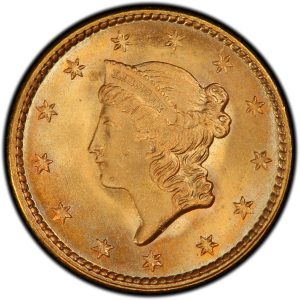
  • Gold Dollar Type 1 (1849-1854)

    1849–1854 · 1 Dollar · 90% gold, 10% copper

    The Type 1 Gold Dollar, struck 1849 to 1854, was the first United States gold dollar and the smallest gold coin the nation ever…

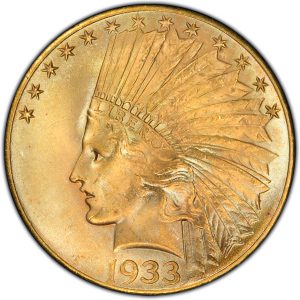
  • Indian $10 Eagle (1907-1933)

    1907–1933 · 10 Dollars (Eagle) · 90% gold, 10% copper

    The Indian Head $10 Eagle, struck 1907 to 1933, is a 90% gold coin designed by Augustus Saint-Gaudens.

  • Indian $5 Half Eagle (1908-1929)

    1908–1929 · 5 Dollars (Half Eagle) · 90% gold, 10% copper

    The Indian Head $5 Half Eagle, struck 1908 to 1929, is a 90% gold coin with an unusual incuse design that is sunk into…

  • Liberty Head $20 Double Eagle (1849-1907)

    1849–1907 · 20 Dollars (Double Eagle) · 90% gold, 10% copper

    The Liberty Head Double Eagle, authorized in 1849 and struck from 1850 to 1907, is a large 90% gold $20 coin from the Gold…
See all Gold Coins →

Buy and sell gold, silver and platinum with Marcus Metals

See live buy and sell prices on bullion bars and coins, or get a quote for your own gold and silver.